
Effingham VINELink Release Coverage
Georgia VINE is a custody-status and notification network. It helps locate a person in a participating agency and can send notice when a reported custody event changes. For Effingham County, it should be used as an alert and verification lead for county-jail or state-corrections custody, not as a full archive of every past booking.
VINE and VINELink refer to related parts of the same service. VINE is the notification program; VINELink is its public web access point. Coverage depends on data supplied by participating agencies. The result may identify custody status and the responsible agency, but it generally does not provide the complete charge history, bond record, detainers, court disposition, or certified release sheet.
The official Georgia entry page is shown in the matching manifest capture:
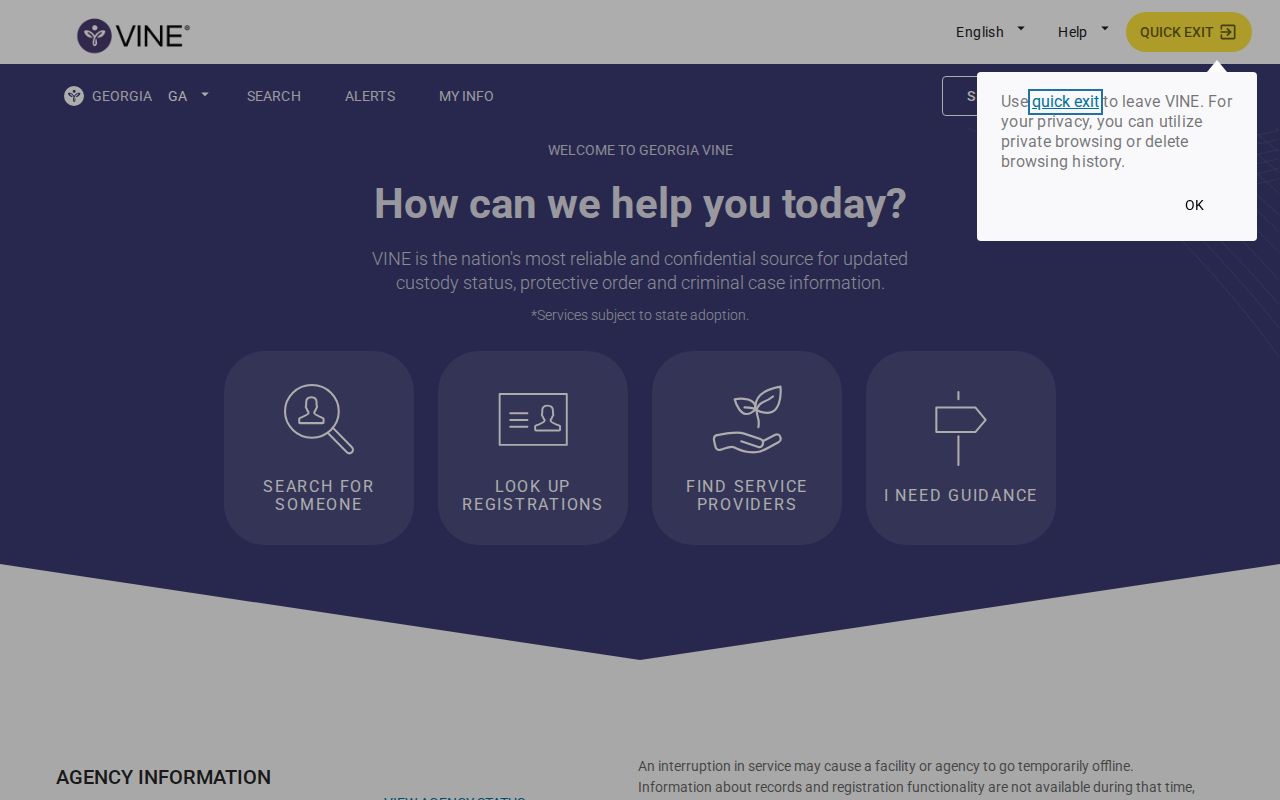
The state screen is the correct starting point because no separate Effingham SAVIN or county VINE page was found.
Search Effingham Inmates on VINELink
A careful one-person search uses enough detail to avoid a false match. Names can repeat, and a person may have records in more than one custody system. Compare the listed agency, facility, age or date details, and identification number when those fields appear.
- Open Georgia VINE and select the offender or person search.
- Enter the full first and last name. Add an ID when one is known.
- Use a partial name only if the exact spelling fails and the interface permits it.
- Review all matches and select the record whose agency and identifying details fit.
- Open the record details and read the custody status and listed location.
- If the status says released, confirm the formal date and reason with the agency that held the person.
A missing VINE result does not prove that the person was never booked or has been released. Try the official Effingham Booking Desk for local custody or the GDC offender search for a state prisoner. The Effingham County release search maps those sources by custody type.
Effingham VINELink Release Fields
Fields vary by agency and record. The Georgia VINE page supports offender location, notifications, and victim-service access, while the source research supports only a general description of a released result. Do not expect the county’s full BlueHorse booking record to appear inside VINELink.
| Field | How to read it |
|---|---|
| Name or offender identity | Helps select the intended person from search results. |
| Custody status | Reports the current state supplied to VINE by the agency. |
| Facility or agency | Identifies the organization responsible for the reported custody event. |
| Identification details | Can help separate records for people with similar names. |
| Notification option | Shows whether a user can register for future event alerts. |
| Release or custody change | Signals a status change but not a certified release reason. |
A released status means VINE received and displayed a custody change. It does not say, by itself, that every hold ended or that the person returned to the community. The person may have transferred to another jail, GDC, federal custody, or ICE.
Match the agency before interpreting the status. An Effingham County Jail entry concerns the local booking. A GDC entry concerns state corrections custody and can relate to a person housed at the Effingham County Correctional Institution. Those records are not interchangeable. The county institution houses state and county offenders under a GDC arrangement, so the listed custodian and offender identifier are more useful than the county name alone.
Scheduled information also differs from an actual event. A projected release date is an estimate based on sentence rules and current credits. A tentative parole month is a Board planning point, not a final order. A VINE release alert reports a custody change received by the network. When the exact legal date matters, compare the alert with the jail release record, GDC record, or court order.
Register Effingham Release Notifications
Registration begins from the correct person’s record. Available methods can include email, text message, telephone call, or TTY. A PIN is used for phone-alert confirmation and notification control. Choose contact methods that can be checked reliably, and keep the PIN private.
- Select the correct offender from the Georgia VINE results.
- Choose “Get Notified” from that record.
- Add one or more offered notification methods.
- Select email, text, phone call, or TTY as available.
- Continue to the PIN step and create a four-digit PIN.
- Finish registration and retain the confirmation details.
A Georgia local VINE explanation confirms that the four-digit phone PIN tells the system the correct recipient received the notice and can stop repeated calls. It is not an inmate ID, booking number, or security code issued by Effingham County Jail.
Note: Register before the expected event when possible, since an alert cannot recreate notices that occurred before registration.
No Separate Effingham VINE Layer
No county-specific Effingham SAVIN page was found. Users should begin with Georgia VINE and then move to the local source that created the record. For a county-jail release, that means the Effingham County Jail, BlueHorse booking record, Sheriff’s records process, and relevant court docket.
If an actual release date, bond status, hold disposition, booking sheet, or release reason is required, submit an Effingham Sheriff Open Records Request. The Sheriff lists the jail phone as 912-754-9715 and the office phone as 912-754-3449. The request route can produce a record tied to the local booking rather than a notification-system summary.
A state prisoner follows a different path. Use the Georgia Department of Corrections offender search and written Inmate Records verification. A person may be outside prison yet still be on parole through the State Board and supervised by the Department of Community Supervision.
The county court path can answer questions that VINE cannot. Effingham Magistrate Court handles early proceedings such as first appearances and preliminary matters. Superior and State Court records may show bond, sentence, dismissal, or another disposition. A court order can explain why custody changed, while VINE reports only the resulting status supplied to the network.
The Sheriff’s BlueHorse structure contains booking number, book and release dates, charges, bond, court history, and detainer functions. Those fields form a much fuller local record than a notification result. Ask specifically for them when the public past-inmate tool is unavailable. The observed public setting may block past results even though the interface contains the controls.
Confirm Effingham VINELink Releases
VINELink data can lag behind the event at the jail or prison. It also does not cover federal Bureau of Prisons custody. For a federal record, use the BOP inmate locator. BOP explains that a past release date with no facility shown means the person is no longer in BOP custody, though another form of supervision or custody may still apply.
ICE custody also requires the ICE Online Detainee Locator rather than VINELink. A local jail record may show only that Effingham released or transferred the person. The receiving system determines what happened next.
Georgia VINE remains most valuable for timely notice. It should be paired with the formal record when exact facts matter. A custody alert answers whether the network reported a change; the booking sheet, court docket, or discharge record explains the legal and agency details behind it.
Alerts can also arrive after a person has already moved. Keep the registered contact information current, answer phone notifications when safe to do so, and use the PIN to acknowledge a call. If a notice seems inconsistent with the jail or GDC screen, contact the agency shown on the VINE record first. It supplied the custody data and can clarify whether the event was a release, transfer, or correction.
For continuing supervision, check the right state tool. The Board parolee search addresses people released on parole, and DCS handles field supervision for parolees and felony probationers. Effingham County is served regionally from Statesboro rather than through an Effingham-named DCS office. That fact can explain why the post-release office shown in a record is outside the county.
- Custody status
- The person’s reported state in the participating agency’s data.
- Release alert
- A notice that VINE received a qualifying change.
- Transfer
- Movement to another agency, which may continue confinement.
- Certified record
- An official record obtained from the agency or court that created it.
Keep the alert details beside the later agency response. Note the time VINE sent the notice, the agency named in the result, and the time the official record was checked. That sequence can explain an apparent conflict caused by data lag or a rapid transfer. For an Effingham County Jail event, ask the Sheriff for the release date, reason, bond or hold status, and booking sheet. For a GDC event, compare the offender record with written Inmate Records verification.
A release notice can also be followed by community supervision. The Parole Board's database may show a person released on parole, while the DCS Statesboro Field Office serves Effingham County supervision. Probation comes from a court rather than a VINE alert. These sources should be checked only when the known case path supports them. VINELink reports the custody change; the Board, DCS, court, or jail explains the legal status that follows.
Notification delivery and record accuracy are separate issues. A valid alert may arrive after the jail completed processing, and a missed call does not reverse the custody event. Keep more than one offered contact method active when reliable notice matters. Confirm that the selected person, agency, and facility still match the intended record before changing notification settings. Similar names and moves between agencies can otherwise make an accurate notice seem wrong.
When the status cannot be reconciled, contact the agency named by VINE first. For Effingham County Jail, use the jail or Sheriff's open-records route. For a state offender, use GDC and its written verification channel. For federal custody, VINELink is not the source, so move to BOP. The official custodian can distinguish release, transfer, data correction, and a later return to custody in a way the short alert cannot.