
Effingham County Release Paths
Effingham County has two main custody tracks. The Sheriff's Jail receives and processes people charged with felony and misdemeanor offenses. Some people leave after bond, recognizance, dismissal, time served, or a court order. Others are transferred because another agency has authority to hold them. The Effingham County Correctional Institution is different. It houses state and county offenders under a Georgia Department of Corrections arrangement, so its state-sentence releases are traced through GDC, parole, and supervision records.
A person who vanishes from the current jail roster has not necessarily returned to the community. The next event may be a release, transfer to GDC, pickup on another warrant, federal custody, or an immigration hold. The booking record, court case, bond status, and any detainer must be read together. For a state offender, the GDC record and parole tools take priority over the county jail list. The source must match the custody that actually ended.
- Release
- The end of custody in one facility, which may lead to the community or another agency.
- Discharge
- Formal completion of the sentence or supervision status shown by the responsible agency.
- Detainer
- A request or legal basis for another agency to keep or take custody.
- Time served
- A court disposition crediting time already spent in custody toward a sentence.
Effingham County Release Types
Local records do not use one simple route for every release. A bond can resolve the hold on one case without clearing a second warrant. A misdemeanor sentence may be completed at the county jail, while a sentence over one year becomes a GDC matter even if the person waits locally for state pickup. Court action may also dismiss a charge, modify a sentence, impose probation, or direct release. Each event creates a different paper trail.
| Release type | What it means | Best next source |
|---|---|---|
| Bond or recognizance | The local case allows release, subject to other holds | Jail booking, bond record, and court docket |
| Time served | The court credits custody toward the sentence | Release record and sentencing docket |
| Dismissal or court order | Court action removes or changes the local basis to hold | Clerk or Magistrate record |
| GDC transfer | County custody ends as state custody starts | Jail transfer entry and GDC search |
| Parole or max-out | A state prisoner leaves under supervision or at sentence end | GDC, Parole Board, and DCS |
| Federal or ICE transfer | Another government system receives the person | BOP, ICE, or the responsible federal office |
The word “released” therefore describes an exit from one custody point. It does not by itself show where the person went, whether supervision began, or whether another hold remained active.
Effingham County Release Record Fields
The official county Booking Desk leads to the BlueHorse jail-management system. Its structure ties release information to a booking rather than to a stand-alone certificate. The researched fields include identifying numbers, book and release dates, charges, bonds, courts, and detainers. Some public controls may be limited, so the visible screen should not be treated as the complete agency record.
| Field | What it shows |
|---|---|
| Booking and jacket numbers | The local custody record used to distinguish bookings |
| Book date and time | When the jail recorded the admission |
| Release date | When that booking shows an exit from the jail |
| Arrest agency | The agency tied to the arrest or booking |
| Charge, case number, and disposition | The offense entry and links to court action |
| Bond information | Bond terms and activity recorded for the case |
| Detainer or hold | A possible barrier to immediate community release |
| State ID or GDC identifiers | Numbers that may connect the person to state records |
A release reason may require a direct records request because the public labels do not promise a full explanation. Ask for the booking and release record, release date and reason, applicable bond entry, and detainer or transfer information. Supplying a booking number or court case number can narrow the search.
Request Effingham County Release Records
The Sheriff's Open Records Request page provides the fallback when the public booking view does not show enough. Requests may be made in person in the administration-building lobby. Questions are directed to Tonya Hodges at thodges@EffinghamCounty.org. The listed administrative address is 500 W. 1st Street, Springfield, Georgia 31329; the Sheriff's Office number is 912-754-3449 and the Jail number is 912-754-9715.
- Identify the person with full name and date of birth, then add the booking or case number if known.
- Describe the precise record sought, such as the booking sheet, release date and reason, bond entry, detainer clearance, or transfer record.
- Submit the request through the method stated on the Sheriff's Open Records Request page.
- Ask for a cost estimate if search, redaction, copies, or another format may create a charge.
- Compare the response with the court docket or receiving-agency record when custody moved elsewhere.
O.C.G.A. Section 50-18-71 permits copy charges up to ten cents per letter or legal page, actual cost for other media, and eligible search, retrieval, and redaction charges. Responsive records must be produced within a reasonable period not exceeding three business days, subject to statutory limits and exemptions. That period can yield records, a timetable, a lawful withholding explanation, or a cost response rather than instant production in every case.
Effingham Sheriff's Records Route
500 W. 1st Street
Springfield, GA 31329
Sheriff: 912-754-3449
Jail: 912-754-9715
Administrative hours: Monday-Thursday, 8:00 a.m.-6:30 p.m.
Effingham County Record Law
Georgia's Open Records Act, O.C.G.A. Sections 50-18-70 through 50-18-74, governs access to local government records. Section 50-18-71 addresses production and fees. A request should seek an existing record and use enough facts to let the custodian locate it. The law does not make a live roster a permanent archive, nor does it require every release detail to appear on the public booking screen.
Access can also change after later legal action. A sealed, restricted, or lawfully withheld record may not remain available in the same form. Booking photographs have an added rule under O.C.G.A. Section 35-1-19. An arresting agency may not provide a photo when it may be placed on a publication or website that demands payment or other value for removal. The safest release verification rests on text records from the jail, court, GDC, or supervising agency, not on a photo alone.
Effingham Bond Release Delays
Effingham's online bond process contains a key local warning. An online credit-card payment is treated as a cash bond, and the transaction is non-refundable. The county says the bond is returned to the arrestee after the case is resolved, not to the person who paid online, unless the surety appears at the jail and completes the proper form before release. That detail matters when family or friends arrange payment.
Payment does not guarantee immediate release. Jail staff should be asked about active holds and detainers before relying on the bond transaction. One charge may be bondable while another case, warrant, transfer order, or agency hold remains. The jail may need time to confirm payment and review every basis for custody. A valid bond on one case can therefore coexist with continued detention or transfer.
The release record should show the actual exit rather than the time payment was made. When timing matters, compare the bond receipt, jail release date, court case, and hold information. The official online bond page supplies the county's terms; jail staff can address the current custody record.
Effingham Release Record Corrections
A release does not automatically delete the booking, court, or commercial copies of a mugshot. The Georgia Attorney General explains that O.C.G.A. Section 10-1-393.5 requires a qualifying commercial website to remove a mugshot without charge within thirty days after a written request when one of the law's listed circumstances applies. Eligibility depends on the case outcome and statutory terms.
That commercial removal process is separate from an agency records request. Correct a wrong jail field with the Sheriff's records custodian, a court entry through the responsible clerk or legal process, and a state correctional field through GDC. Keep the release response and final court disposition together. They can show why a public booking image or stale copy no longer tells the full story.
No payment-for-removal service is needed to read the Attorney General's official explanation. Use the government source, document the qualifying event, and send the written request described by law. Sealing, restriction, expungement, and commercial removal are distinct processes, so one should not be claimed as the result of another.
Find Effingham County Released Inmates
A reliable search begins with the custody source, not with a broad name result. Someone booked at the Effingham County Jail follows a local jail, bond, and court path. A state prisoner housed at the correctional institution follows GDC and parole records. A person transferred on a federal or immigration hold follows a third system after the county release entry.
- Open the official county Booking Desk and search the current BlueHorse list.
- If the name is gone, look for a past-inmate or recent-booking control, but do not treat absence as proof.
- Call the jail or request the booking and release record when public past results are unavailable.
- Check Superior, State, or Magistrate court records for bond, dismissal, sentence, probation, or transfer events.
- Search GDC when the person received a state sentence or moved into state custody.
- Use parole, VINE, BOP, or ICE only when that system matches the known custody path.
The Effingham releases from the last 24 hours page addresses the county's recent-feed limits. For a named person, the final answer may require both the jail release record and the court or receiving-agency record.
Effingham GDC Release Search
The GDC Find an Offender tool covers Georgia prison custody, including state offenders housed at Effingham County Correctional Institution. It is not the right database for a person who only bonded out of the county jail. GDC allows searches through personal data, name, GDC identification, or case information where available. Broad name variants can help when punctuation, a middle name, or an alias differs.
| Search field | How it helps |
|---|---|
| Name and personal data | Starts a search when no agency number is known |
| GDC ID | Matches the state correctional identity |
| Case number | Connects a result to a known prosecution |
| Status and location | Shows whether state custody appears current |
| Sentence and offense | Helps confirm the correct record |
| Release or maximum date | Shows a state date that may require interpretation |
Read a Tentative Parole Month as tentative, not final. The Board completes a later review and may then set a release date. A Maximum Release Date is a different sentence-calculation field. GDC also warns that its data may be incomplete and asks users to verify through written correspondence with Inmate Records and Information, P.O. Box 1529, Forsyth, GA 31029.
The official GDC interface is shown in the captured source below.
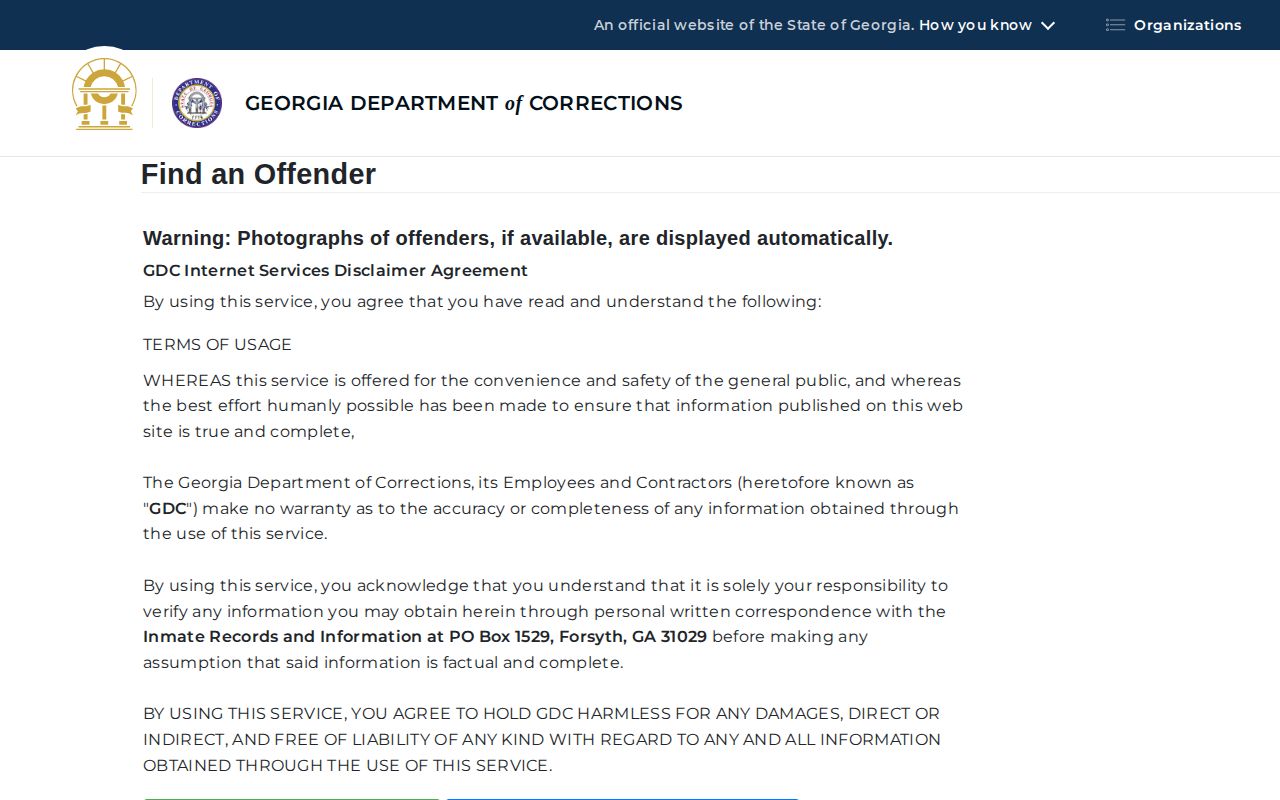
The search form confirms why names, identifiers, state status, and sentence data must be matched before treating a result as the correct released person.
Effingham Court Release Proof
Effingham's court split is important after a jail release. The Clerk of Superior and State Court manages those court records from Suite 110 at 700 N. Pine Street in Springfield. Magistrate Court operates from Suite 250 and handles preliminary and local matters that can include first appearances, hearings, arraignments, and bond-related events. The jail roster cannot replace either docket.
A court record may explain why a person left custody when the public booking screen only shows a date. Look for a bond order, dismissal, sentence, probation term, transfer consequence, or final disposition. The Clerk's case-management page leads to Superior and State Court records. The official Magistrate Court material covers its separate jurisdiction.
The county court source appears in the captured image below.
The separate court route helps explain a bond or hearing outcome that may not be stated in the live inmate list.
Match the case number from BlueHorse to the docket where possible. If several charges exist, one disposition may not resolve all of them. Court proof and jail proof answer related but distinct questions: the court explains the legal event, while the jail records the custody exit or transfer.
Effingham Supervision After Release
A state prisoner can be outside a prison and still be under parole or felony probation supervision. The Georgia State Board of Pardons and Paroles makes parole decisions and maintains a parolee search. The Georgia Department of Community Supervision handles field supervision. Effingham County is served by the Statesboro Field Office rather than an Effingham-branded DCS office.
The Statesboro office at 15 N. Main Street serves Effingham along with other counties and the Ogeechee Circuit. Its phone is 912-871-1119. That regional arrangement explains why an Effingham resident's record may point to Statesboro. It is not evidence that the person was released from a Statesboro jail.
Use the Board's parolee database for someone believed to be on parole. Use a court docket for probation imposed in an Effingham case. Then use DCS to confirm the field-office route when appropriate. Parole means conditional release from prison after Board action; probation is a court-ordered sentence or sentence component. Discharge means the relevant term has formally ended, not merely that the person has left a building.
Effingham Release Alerts and Registries
Georgia VINE provides custody-status checks and custody-change notifications through VINELink. Search by name or identifier where supported, confirm the correct record, and register for the available phone, text, email, or TTY notice. An alert can help track a release or transfer, but VINE is neither a certified release record nor a full historical jail archive. Verify the notice with the jail, GDC, or court that owns the record.
The Georgia Sex Offender Registry is a separate statutory system. It applies only to people with a registration duty under Georgia law. A qualifying released person may remain visible there even after jail or prison custody ends, but the registry is not a general Effingham County released-inmate list. GBI notes that contributing agencies supply the data and that it changes often.
These tools answer narrow questions. VINE supports notice of custody changes. The registry confirms a legal registration status. Neither explains the full reason for an Effingham jail release, the terms of bond, or every court disposition.
Effingham Federal Release Transfers
A local jail record can show when Effingham County custody ended, yet it may not show the final destination in enough detail. If a federal agency received the person, use the federal system next. The Bureau of Prisons locator covers federal inmates from 1982 forward. BOP says a past release date with no facility location means the person left BOP custody on that date, though supervised release or custody elsewhere may still follow.
ICE's Online Detainee Locator System is for current ICE custody and qualifying CBP custody over forty-eight hours. A person transferred from the county jail on an immigration hold may disappear from BlueHorse while appearing in ICE custody later. If no ODLS result appears, USA.gov and ICE advise contacting the proper Enforcement and Removal Operations field office. A no-result search is not proof of community release.
Federal pretrial custody can also involve the U.S. Marshals Service, which handles federal prisoner housing and transport from arrest through acquittal or incarceration. The county release record confirms the local exit. BOP, ICE, or the federal custodian confirms what followed.
Effingham Jail History Context
Effingham's detention records span several jail sites and eras. The county's history says people held before 1918 were kept in a small block structure near Pine and Early Streets. A two-story jail was built in 1934, and the Sheriff's Office moved in 1993 after the prior location became too small. Reports later described a major jail project opening around 2014.
Those later reports use different bed figures and project scopes. One described more than 300 beds, while a design-build account identified a 204-bed scope. Neither figure should be presented as the current official capacity without a current source. The useful point for release research is that an old booking or discharge record may name a prior jail building, address, or operating arrangement.
Modern release checks should still begin with the current Sheriff's Booking Desk, jail contacts, courts, and records request. Historical context helps interpret an older document; it does not change today's custodian or turn an old facility reference into a current place of confinement.
Effingham Custody Status Comparison
The same name can appear in more than one system, and each system has a different time frame. Start with the source most closely tied to the known arrest, sentence, or transfer. Then use a second source to explain the next event.
| System | Still in custody | After release or transfer |
|---|---|---|
| BlueHorse county booking desk | Current local jail booking | Release field or restricted past-inmate controls; request records if needed |
| Effingham court docket | Pending hearings and custody-related orders | Bond, dismissal, sentence, probation, or final disposition |
| GDC offender search | State facility and sentence status | Released, discharged, parole, or date information when recorded |
| Parole Board and DCS | TPM may relate to a person still imprisoned | Parolee status and field supervision |
| VINELink | Participating-agency custody status | Release or transfer alert, not a certified record |
| BOP or ICE | Federal or immigration custody when covered | BOP release-date history or agency follow-up |
Can absence from BlueHorse prove release? No. It shows only that the current public view does not display the person. Call the jail, check court and receiving-agency records, or request the release record.
Does release end all supervision? Not always. Parole, probation, registry duties, or federal supervised release can continue outside a jail or prison.
Effingham County Release Facilities
The facility map includes custody sites plus the official court, corrections, supervision, notification, registry, and federal systems needed to trace where a release went. The Sheriff's jail and correctional institution are the physical detention facilities. The other entries are distinct record or custody channels and should not be mistaken for county jail branches.
- Effingham County Jail: local booking, bond, short-term custody, misdemeanor service, release, and transfer records.
- Effingham County Correctional Institution: county institution housing state and county offenders, with state releases traced through GDC.
- Effingham County Superior Court / State Court: docket proof for bond, sentence, dismissal, probation, and case outcome.
- Effingham County Magistrate Court: preliminary and local proceedings that can affect early release.
- Georgia Department of Corrections offender search: state custody, sentence, status, and release-date path.
- Georgia State Board of Pardons and Paroles: tentative parole and released-parolee records.
- Georgia DCS Statesboro Field Office: regional parole and felony probation supervision for Effingham County.
- Georgia VINE / VINELink: custody-change lookup and alerts for participating agencies.
- Georgia Sex Offender Registry: separate registration status for qualifying released people.
- Federal Bureau of Prisons inmate locator: federal custody and historical or projected release dates.
- ICE Online Detainee Locator System: current immigration custody after a qualifying transfer.
Use the first record to establish where Effingham custody ended, then the next system to confirm whether the person entered community release, supervision, state custody, federal custody, or immigration detention.
Public Record Search
Sponsored Results