
Effingham 72-Hour Release Access
No official standalone Effingham County 72-hour release URL was confirmed. The county’s Booking Desk links to BlueHorse, which contains a Past Inmate panel and begin-date and end-date fields. In theory, those fields could cover three days. During research, however, the jail information service returned PastInmatesPublic:"0". That setting indicates that public past-inmate results may be disabled.
A three-day window remains useful as a records concept. It catches releases that occurred before a weekend search, spans more than one court day, and helps account for a roster update that did not appear at once. It should not be presented as a live county feed when the Sheriff has not published one.
Find Effingham Three-Day Releases
Start by setting the exact dates and times that define the period. “Last 72 hours” is a rolling span, while “the last three calendar days” can cover a different set of events. Give that range to the jail or include it in a records request. A clear range reduces the risk of missing a late-night booking or counting a release outside the intended window.
- Search the official BlueHorse current roster for each known name.
- If the Past Inmate date fields appear and work, enter the start and end dates for the three-day span.
- Call Effingham County Jail at 912-754-9715 when the past search is locked or unclear.
- Check Magistrate, State, or Superior Court records for bond, dismissal, sentence, or transfer orders.
- File a Sheriff’s Open Records Request for the booking and release record when written proof is needed.
For one named person, the Effingham County released-inmate search separates county, state, and federal paths. For only the newest events, use the Released Last 24 Hours process.
Effingham Three-Day Record Fields
The BlueHorse data structure identifies the fields that can support a three-day release review. Public access may expose only some of them. A formal request can ask for the exact booking record, release date, release reason, and destination.
| Field | Why it matters |
|---|---|
| Full name and identifiers | Distinguish the correct person from similar names. |
| Booking number | Connect the request to one jail stay. |
| Book date and time | Place entry into custody inside or outside the range. |
| Release date | Shows whether the recorded exit falls in the three-day span. |
| Charge and disposition | Connect custody to the case and any recorded result. |
| Bond | Shows a possible release route but not clearance of every hold. |
| Detainer or hold | May explain continued custody or transfer after local release. |
The public labels do not guarantee a complete release reason. A date can show that the local booking ended without showing whether the person went home or entered another agency’s custody.
Effingham Weekend Release Timing
Weekend and holiday searches often cross more than one type of event. Bond may be posted, a court order may reach the jail later, or another agency may arrive for pickup. Effingham County does not publish a public update cadence for BlueHorse, so no fixed refresh interval should be assumed. A record can also change after the first screen view as staff finish processing the release.
Use the court docket to test the cause of a status change. Magistrate Court handles preliminary matters and early proceedings, while State and Superior Court records may show the later case action. A jail clerk can address the custody event; the court can explain the order behind it.
Note: A 72-hour range helps with delayed viewing, but it does not cure a disabled public past-inmate search.
Effingham Past-Inmate Access Gap
The local system’s controls and settings point in different directions. BlueHorse contains past-search functions, date fields, and a “Books 24hr” tool, while its observed jail setting blocks public past-inmate results. This is the distinctive Effingham roster issue. It means a user may see the machinery for a historical search yet receive no usable results.
Absence from the live list is not enough. The person could have been released, transferred to GDC, collected on an out-of-county hold, or moved to federal or immigration custody. Confirm the release date and ask for the receiving agency when applicable. Georgia VINE can report a custody change, but it does not replace the Sheriff’s booking sheet or a court disposition.
Effingham Release Custody Paths
Effingham has both a county jail and a county correctional institution that houses state offenders. Those systems create different release trails. A short local jail stay is best traced through BlueHorse, the jail, bond data, court records, and the Sheriff’s records process. A state-sentence release from the correctional institution belongs in the Georgia Department of Corrections offender search and may lead to parole supervision.
| Event | Best next source |
|---|---|
| Local bond or court release | Effingham jail record and court docket |
| Transfer to GDC | GDC offender search and inmate records |
| Parole release | State Board parolee search and DCS |
| Federal transfer | BOP locator or responsible federal agency |
| Immigration hold | ICE detainee locator after local transfer |
A release from one agency ends only that agency’s custody event. Ask where the person went before concluding that confinement ended.
For GDC custody, search by the identifying fields the state provides and review the listed status, facility, sentence, and release information. GDC warns that its public results may be incomplete and directs users to written Inmate Records correspondence for verification. That warning is important during a three-day review because a county transfer and a state intake may not appear at the same moment. A court docket can establish the sentence or order, while GDC establishes the later state record.
Parole is another distinct event. It means release from prison under conditions set by the State Board, not the end of all legal supervision. The Board’s parolee database and the Department of Community Supervision can confirm the supervision path. Effingham is served by the DCS Statesboro Field Office. Probation usually follows a court sentence and is also supervised through DCS for felony cases. Neither status belongs in a county jail release feed, even though both may begin after a person leaves confinement.
Effingham Jail Record Context
Local jail history helps explain why old stories may refer to different buildings or project figures. The county’s jail history describes earlier facilities and moves, while reports about the newer jail project use different bed counts and scopes. Those figures should not be treated as a current capacity statement.
The available Effingham Herald project article is captured in the matching manifest image:
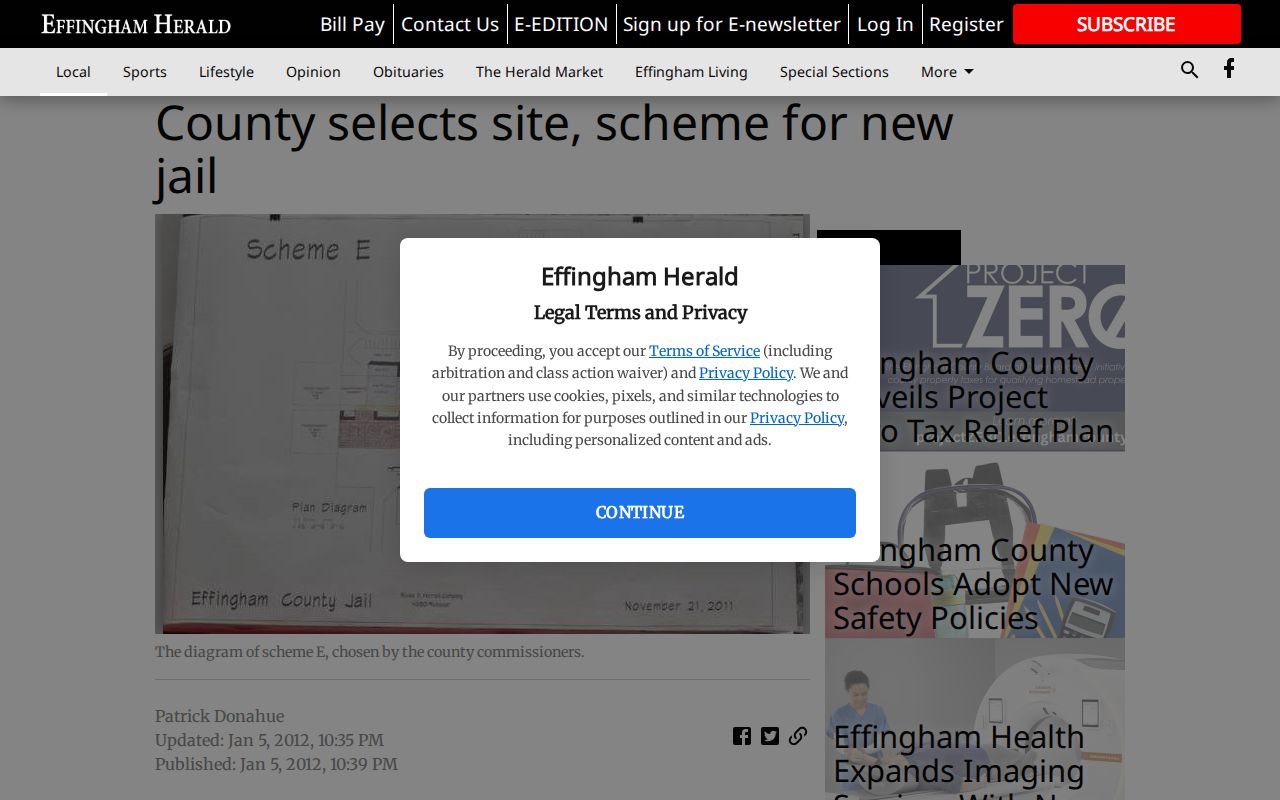
The image supplies facility context, not a list of people released in a three-day period. Individual status still requires the jail and court sources.
Keep a simple timeline while checking the range: booking time, court event, bond or sentence event, recorded jail release, and any later agency admission. A timeline exposes gaps that a single roster screen hides. If the jail gives only verbal confirmation, note the date and office contacted, then seek the written record when exact proof is needed.
Records can also use terms that sound alike. “Released” ends the listed custody event. “Transferred” moves the person to another custodian. “Time served” is a court credit for confinement already completed. A “detainer” is another agency’s request to hold or receive the person. Reading those terms correctly prevents a three-day list from being treated as a list of people who necessarily returned home.
When the three-day span crosses several court days, request the release record by exact start and end dates. Include the full name, date of birth, booking number, and case number when known. The Sheriff's records page lists both the jail and office telephone routes for questions. A narrow date range helps the custodian find the relevant booking without implying that every person who left the current roster was released to the community. Compare each recorded exit with the case docket and any receiving-agency entry.
Build the range from recorded events rather than a single search time. Note the jail booking, the court action, the bond or sentence event, the release entry, and any later admission to another system. This is especially useful across a weekend because a Friday court order and a later jail exit may fall on different dates. Effingham does not publish a fixed BlueHorse refresh schedule, so the public display cannot establish the exact processing interval.
If the result is a transfer, continue with the receiving source. A sentence over one year can move the record into GDC custody. A federal or immigration hold requires the federal or ICE locator path after the local booking ends. Georgia VINE may send a custody-change alert, but the Sheriff's response and the receiving-agency record establish what the three-day event actually represents.